Saffron for Eyesight: What the Macular Degeneration Trials Show
Saffron extract has been studied in a few small trials of people with age-related macular degeneration (AMD), and the early results are interesting. But the evidence is limited, and saffron has not been shown to protect vision the way the AREDS2 formula has. Anyone with AMD should work with an eye doctor, and saffron should not replace monitoring or treatment.
- Saffron was studied in a few small trials in people with AMD, and the evidence is limited and preliminary.
- Saffron has not been shown to protect vision, and it is not a substitute for eye exams or treatment.
- AREDS and AREDS2 are the large NEI-backed trials; saffron has no comparable evidence.
- The sources reviewed do not set a saffron dose or detail its safety, so ask a doctor or pharmacist first.
- Two of the four products we reviewed list saffron, and none has verified trial data on the finished product.
Does saffron help eyesight? The short answer
Saffron may support retinal health in early AMD, but the research is small and preliminary. The studies were published in[1] and[2], and a later review of saffron therapy for AMD appeared in[3]. None of this is enough to say saffron protects sight or slows the disease.
By comparison, the AREDS and AREDS2 formulas were tested in large trials run by the National Eye Institute[4]. Saffron has nothing comparable yet.
Saffron is not a treatment for any eye disease. Blurry or distorted vision should be checked by an eye doctor, since the cause may be something other than AMD, such as cataracts or a refractive change. For more on that, see vitamins and blurry vision with age.
Saffron extract for eyesight reviews: what the small AMD trials studied
Three sources make up most of the saffron-and-AMD literature available here:
- A longitudinal follow-up in early AMD. This study followed people with early disease who took saffron over time[1].
- A double-blind randomized trial. This design compares saffron with a placebo without participants or researchers knowing who received which, which makes it the stronger of the small studies[2].
- A 2024 review of saffron therapy for AMD. It brings the saffron findings together in one place[3].
These studies looked at people who already had AMD, not at healthy eyes. A result in early AMD does not show that saffron helps general eyesight in people without the condition.
The exact outcome measures, doses and numbers are best read in the papers themselves. A good question for any reviewer to ask is whether a study measured something that matters to daily life, such as reading and driving, or only a lab-style test of retinal function.
Limits of the saffron evidence
Several limits apply when reading these trials.
- Small size. The trials were small, so chance findings and unusual groups of participants are real possibilities[2].
- Early disease. The follow-up focused on early AMD, so the results may not apply to intermediate or advanced disease[1].
- Short follow-up compared with AMD itself. AMD develops over years, and the large AREDS trials were designed around that long timeline[5].
- No head-to-head comparison with AREDS2. The sources do not show saffron performing better than, or adding to, the AREDS2 formula.
- Little independent replication. Small trials need confirmation in larger, independent studies before firm conclusions are drawn.
In short, saffron is a reasonable subject for more research. It is not yet a proven part of AMD care.
Saffron dose and safety
The sources provided do not establish a recommended saffron dose, so none is given here. Different studies and products use different amounts and extracts, and a dose that was studied in a trial may not match a retail capsule.
Safety data are also limited in the sources reviewed. Anyone considering saffron should:
- Ask an eye doctor or pharmacist first, especially when taking prescription medicines.
- Tell the care team if pregnant, nursing, or managing another condition.
- Check the total content of every supplement taken, since overlap between products is common.
- Be cautious with products that do not list amounts per serving.
The same caution applies to the AREDS-style nutrients. Zinc, for example, has an upper intake level, and high intakes can cause problems[6]. For many people, a multi-ingredient product can raise total zinc or vitamin A intake without it being obvious.
Saffron vs. the AREDS2 formula for macular degeneration
AREDS found that a high-dose combination of vitamins C and E, beta carotene and zinc reduced the risk of progression to advanced AMD in people at higher risk[5]. AREDS2 later tested lutein and zeaxanthin, along with omega-3 fatty acids, as modifications of that formula[7]. The National Eye Institute summarizes the AREDS findings[4].
Those studies were done in people with intermediate or advanced AMD in one eye, not in the general public[4]. That is why AREDS-style formulas are discussed as a question for people already diagnosed, and why an eye doctor should decide whether one fits. See the guide to the AREDS2 formula and the page on nutrients and supplements.
To learn more about the carotenoids in that formula, see lutein and zeaxanthin. For broader background on eye health after 50, see eye vitamins over 50.
Supplements are only one part of the picture. AMD comes in dry and wet forms, and wet AMD may need treatment from an eye specialist[8]. Changes such as wavy lines or a dark spot in central vision warrant a prompt exam[9]. See signs and symptoms and treatment and home care.
How the eye supplements we reviewed compare
Only two of the four products we reviewed list saffron, and none has trial data on the finished product that we could verify.
VisiFlora is the closest match to this guide's subject. Its listed ingredients include saffron extract, along with lutein and zeaxanthin from marigold, zinc, vitamin C, vitamin E, beta carotene, bilberry, ginkgo and others. Those carotenoids and nutrients overlap with the AREDS2 research, and saffron has the small AMD studies described above. Amounts are not disclosed for most ingredients, so it is not possible to tell whether any of them match the doses studied. The page cites no clinical data on the finished product.
iGenics also lists saffron, alongside ginkgo, bilberry, turmeric with BioPerine and unitemized AREDS-2 ingredients. Because the AREDS-2 ingredients are not itemized, their amounts cannot be compared with the studied formula.
TheyaVue lists lutein, zeaxanthin, vitamins C and E, zinc, bilberry, rutin and calcium, but not saffron. Only eight of its claimed 24 ingredients are named.
Vision 20 lists lutein, zeaxanthin, zinc, beta-carotene, lycopene and others, but not saffron. Amounts are not disclosed.
In all four cases, a label that resembles an AREDS-style formula is not the same as the formula tested in the trials. Compare with the AREDS2 formula guide and ask an eye doctor before choosing.
Eye supplements we have reviewed
Want to compare products? Read what the research says about nutrients for macular degeneration first, then compare the products below.
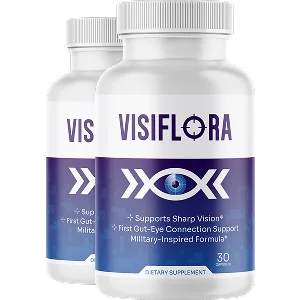
VisiFlora
Lists saffron extract, lutein and zeaxanthin from marigold, zinc, beta carotene, vitamins C and E and bilberry, which relate to the saffron and AREDS2 research. Amounts are not disclosed, and no clinical data on the finished product is cited. Ginkgo, coleus, eyebright and several other listed ingredients have no good evidence for AMD in the sources reviewed.
Listed ingredients: Astaxanthin, Vitamin C, Vitamin E, Copper, Selenium, Chromium
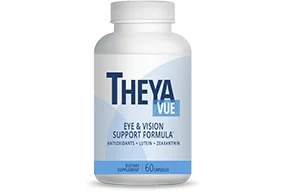
TheyaVue
Lutein, zeaxanthin, vitamins C and E and zinc relate to the AREDS2 research, but amounts are not disclosed and only eight of 24 ingredients are named. It does not list saffron, and bilberry and rutin have no good evidence for AMD in the sources reviewed.
Listed ingredients: Lutein, Zeaxanthin, Vitamin C, Calcium, Vitamin E, Bilberry Extract
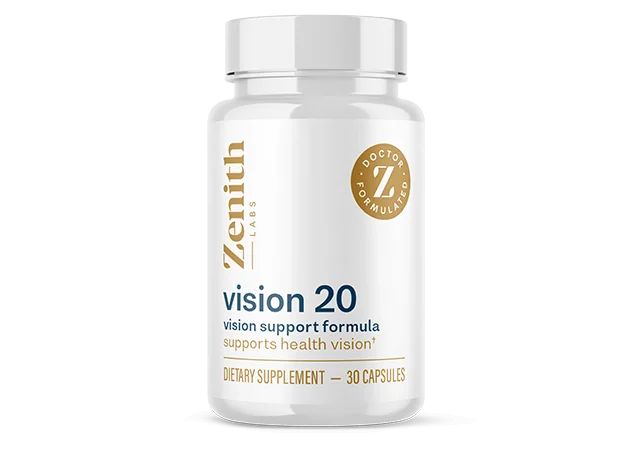
Vision 20
Lutein, zeaxanthin, zinc and beta-carotene relate to the AREDS-style research, but amounts are not disclosed. It does not list saffron, and the evidence for AREDS2 applies to people with existing AMD, not general use. Smokers are generally advised to avoid beta-carotene supplements.
Listed ingredients: Lutein, Zeaxanthin, Zinc, Beta-carotene, Lycopene, Rose Hips
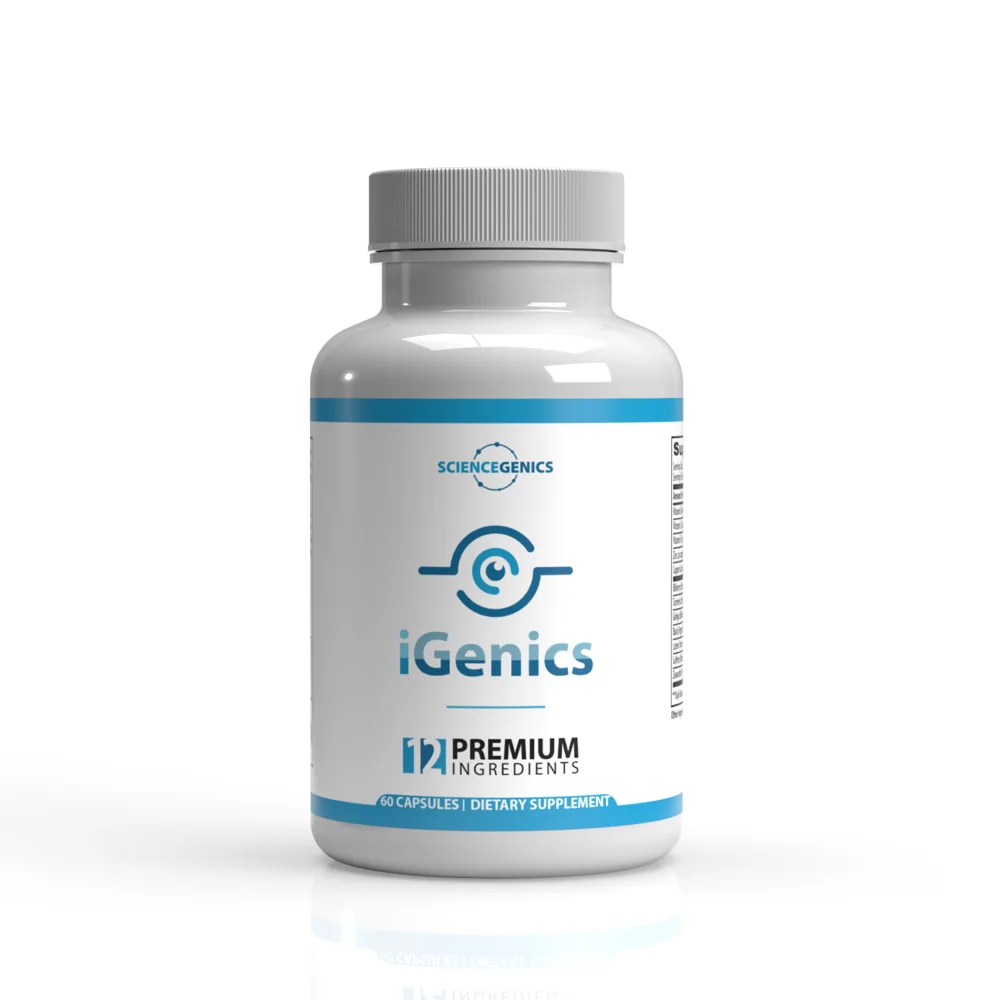
iGenics
Lists saffron, which has small AMD trials with limited evidence, plus unitemized AREDS-2 ingredients, so amounts cannot be compared with the studied formula. Ginkgo, bilberry and turmeric have little good evidence for AMD in the sources reviewed, and ginkgo may interact with blood thinners.
Listed ingredients: Ginkgo biloba, AREDS-2 formula ingredients (not itemized), Bilberry, Saffron, Turmeric + BioPerine
Frequently asked questions
Is saffron good for macular degeneration?
Saffron was studied in small trials in people with AMD, including a double-blind randomized trial[2]. The evidence is limited, and it does not show that saffron protects vision. An eye doctor can say whether it is worth discussing.
Can saffron replace the AREDS2 formula?
No evidence in the sources shows that it can. AREDS2 was a large trial run by the National Eye Institute[4], and the saffron studies were small. Any change to a supplement plan should be reviewed with an eye doctor.
What is the right saffron dose for eyesight?
The sources reviewed do not establish a recommended dose. Doses and extracts vary between studies and products, so a pharmacist or eye doctor should help with this decision.
Should I see a doctor about blurry vision instead of trying saffron?
Yes. Blurry, wavy or distorted vision can have several causes, and some need prompt care[9]. See the guide on blurry vision for more, and book an eye exam.
Sources
- Evid Based Complement Alternat Med 2012: saffron in early AMD, longitudinal follow-up
- Med Hypothesis Discov Innov Ophthalmol 2016: saffron in AMD, double-blind randomized trial
- BMJ Open Ophthalmol 2024: saffron therapy for age-related macular degeneration
- National Eye Institute: Age-Related Eye Disease Studies (AREDS/AREDS2)
- AREDS Research Group. Arch Ophthalmol 2001: high-dose vitamins C and E, beta carotene and zinc for AMD
- NIH Office of Dietary Supplements: Zinc fact sheet
- AREDS2 Research Group. JAMA 2013: lutein + zeaxanthin and omega-3 fatty acids for AMD
- National Eye Institute: Age-related macular degeneration
- American Academy of Ophthalmology: What is macular degeneration?